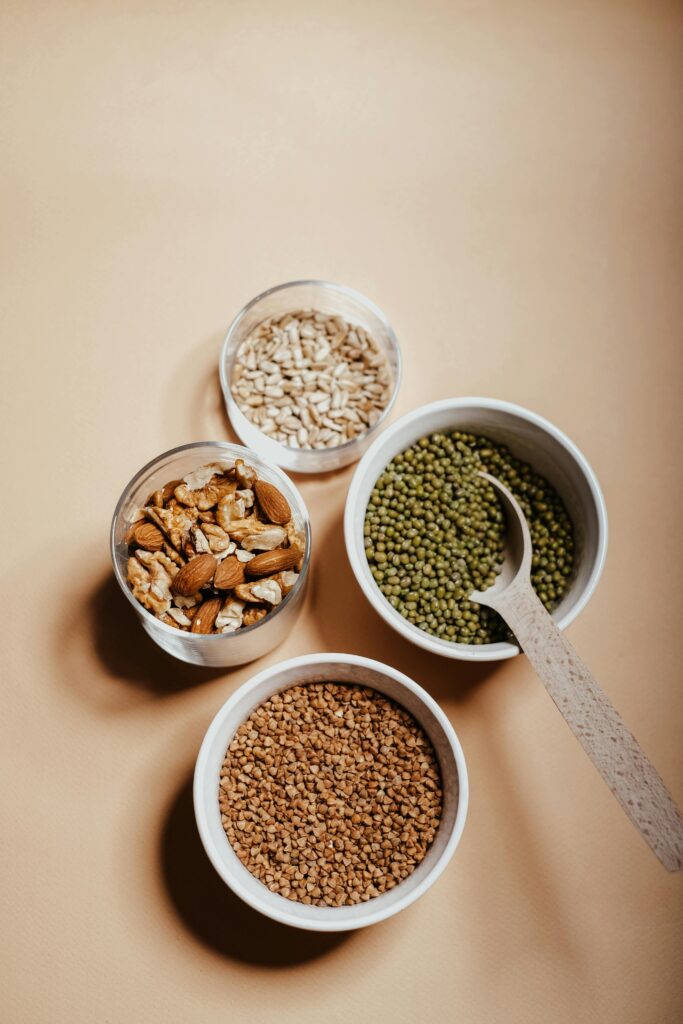

is an essential macronutrient that plays a vital role in building muscle, repairing tissues, and supporting overall health. In this article, we will explore the functions, types, and benefits of protein to help you understand why it is so important for your body.”

are large, complex macromolecules built from one or more long chains of amino acids — the essential molecular machinery behind virtually every process in living organisms. They are central to life in a way no other bio molecule is.
are polymers assembled from 20 standard amino acids joined by peptide bonds. Every amino acid shares a common backbone, a central α-carbon bonded to an amino group (–NH₂), a carboxyl group (–COOH), and a hydrogen plus a unique R-group (side chain) that gives it distinct chemical character.
The order of amino acids , genetically encoded in DNA and assembled by ribosomes determines how each protein folds into its three-dimensional form. That shape governs function entirely. A single misplaced amino acid can be catastrophic, as in sickle cell anemia, where one substitution warps hemoglobin’s structure.
Proteins span an enormous size range: from small peptides of just a handful of residues to vast multi-subunit complexes hundreds of thousands of amino acids long. The human body expresses estimated 20,000–25,000 unique proteins, collectively the proteome.
Key Definition , Peptide Bond
A peptide bond is a covalent linkage formed when the carboxyl group of one amino acid reacts with the amino group of another, releasing water (condensation). Chains under ~50 residues are called peptides; longer chains are polypeptides,
Structure
Levels of Structure
architecture unfolds across four nested levels of organization. Each layer emerges from the one below it, ultimately producing a molecule capable of specific, precise biological work.
1 · Primary
Primary Structure
The raw amino acid sequences a linear chain of residues in a genetically specified order. Every property of the protein ultimately flows from this sequence.
peptide bonds
2 · Secondary
Secondary Structure
Locally folded patterns: α-helices (coiled ribbons) and β-sheets (pleated strands), arising from hydrogen bonds between backbone atoms.
Hydrogen bonds
3· Tertiary
Tertiary Structure
The full 3D conformation of a single polypeptide. All secondary elements compacted and stabilized through hydrophobic packing, ionic bonds, and disulfide bridges.
hydrophobic · ionic · S-S
4 · Quaternaryhttps://amiironline.com/what-are-carbohydrates/
Quaternary Structure
Multiple polypeptide subunits assembled into one functional complex. Haemoglobin (α₂β₂) is the textbook example four subunits cooperating to carry oxygen.
Tertiary forces + interfaces
Function
Classification by Function
The most biologically revealing classification groups, by what they do. The sheer range of protein functions mirrors the complexity of life itself — catalysts, signals, scaffolds, defenders, carriers, and motors all built from the same 20 amino acids.
Class Biological Role Key Examples
Enzymatic Catalyze biochemical reactions with extraordinary speed and selectivity Amylase · DNA Polymerase · Pepsin
Structural Provide mechanical support to cells, tissues, and organs Collagen · Keratin · Elastin
Transport Bind and shuttle molecules — gases, lipids, ions — throughout the body Hemoglobin · Albumin · Transferrin
Hormonal Act as chemical messengers coordinating physiology across tissues Insulin · Glucagon · Growth Hormone
Immunological Recognize and neutralize foreign pathogens and antigens IgG · IgM · IgA antibodies
Contractile Generate force and movement at molecular and organismal scales Actin · Myosin · Dynein
Storage Reserve amino acids, iron, or nutrients for metabolic use Ferritin · Casein · Ovalbumin
Receptor Receive and transduce signals from hormones and neurotransmitters Rhodopsin · Insulin Receptor · GPCRs
Regulatory Control gene expression, cell division, and metabolic networks p53 · Histones · Transcription Factors
Geometry
Classification by Shape
overall geometry is not incidental it directly mirrors its biological role. Three broad shape categories account for the vast majority of known proteins.
Fibrous Proteins
Long, rope-like polypeptide chains wound into cables. Water-insoluble and mechanically robust , the structural materials of biology. Found in connective tissue, hair, nails, skin. Examples: collagen, keratin, fibrin, elastin.
Globular
Compact, roughly spherical shapes; water-soluble. The dominant form for metabolic, transport, and regulatory functions. Most enzymes and all hormonal proteins fall here. Examples: hemoglobin, myoglobin, lysozyme.
Membrane
Integrated within or anchored to lipid bilayers. Span the interface between aqueous and hydrophobic environments to control what enters and exits cells. Examples: ion channels, GPCRs, aquaporins, transporters.
Composition
Classification by Composition
Simple Proteins
Consist solely of amino acids. Hydrolysis yields only amino acid residues with no additional chemical components.
Albumins — blood serum, egg white
Globulins — serum proteins
Histones — DNA packaging
Protamines — sperm chromatin
Keratins — hair, nail, skin
Type Prosthetic Group Notable Example
Glycoprotein Carbohydrate (oligosaccharide) Mucin · Blood group antigens
Lipoprotein Lipid (cholesterol, triglycerides) LDL · HDL · VLDL
Nucleoprotein Nucleic acid (DNA or RNA) Ribosomes · Chromosomes
Metalloprotein Metal ion (Fe, Zn, Cu, Mn) Hemoglobin (Fe²⁺) · Carbonic anhydrase (Zn)
Phosphoprotein Phosphate group Casein · Phosvitin
Chromoprotein Pigment (heme, flavin) Cytochromes · Myoglobin
Clinical Note , Protein Misfolding Diseases
When proteins fail to fold correctly, the consequences can be severe. Alzheimer’s disease involves aggregation of amyloid-β peptides; Parkinson’s is linked to misfolded α-synuclein; cystic fibrosis results from a misfolded chloride channel (CFTR). structure is not merely academic — it is therapeutically critical.
Summary
are the molecular workhorses of biology, staggering in structural diversity, irreplaceable in function, and present in every cellular process. Their classification illuminates this complexity from multiple angles: by function (enzymes, hormones, antibodies, motors), by structural hierarchy (primary through quaternary), by geometric form (fibrous, globular, membrane), and by chemical makeup (simple versus conjugated).https://my.clevelandclinic.org/
At the heart of protein biology lies a single governing principle: structure determines function. The specific fold a protein adopts dictated entirely by its amino acid sequence is the blueprint for everything it does. Disrupting that fold, even subtly, can silence function or produce disease.
Understanding proteins at this level is foundational to biochemistry, medicine, nutrition, biotechnology, and drug design. The more precisely we can describe, predict, and engineer protein structure, the deeper our command over life itself.
References
Bashir Ali
Health & Nutrition Writer | Founder of Amiironline.com
An accomplished Health and Nutrition Writer with a Master’s Degree and 12 years of professional experience in the wellness sector. He is the Founder and Editor-in-Chief of Amiironline.com, a leading digital platform dedicated to simplifying nutritional science and promoting evidence-based health awareness. He specializes in creating high-quality, SEO-optimized health content that bridges the gap between scientific research and public wellness.